SSL Certificate
Deploy an SSL certificate to enable HTTPS encryption of websites, trusted identity authentication and prevent against data leaks or tampering during transmission.
Get SSL Certificate →
Blog > ACME, CLM, or CaaS? Choosing the Right SSL Automation Strategy
Tag:
SSL Automation
ACME
CLM
CaaS
DevOps
PKI
HTTPS Security
Certificate Management
:0
Amy Zhang
In the current market, SSL/TLS automation has evolved into several distinct methods, ranging from standardized open-source protocols to comprehensive enterprise management platforms. These methods are designed to eliminate the risks associated with the industry's shift toward shorter certificate lifespans.
Here are the primary methods available today for SSL automation:
1. ACME Protocol (Automated Certificate Management Environment)
ACME is the industry-standard protocol for automating certificate issuance and renewal, widely adopted by Let's Encrypt and supported by many commercial Certificate Authorities.
How it works: A local ACME client (like Certbot or acme.sh) proves domain ownership to a CA via HTTP or DNS challenges. Once verified, the CA issues the certificate, and the client can automatically install renewed certificates and reload supported services.
Best for: Developers, standard web servers (Nginx/Apache), and organizations looking for a free or low-cost automated solution.
2. Agent-Based Certificate Automation (CaaS)
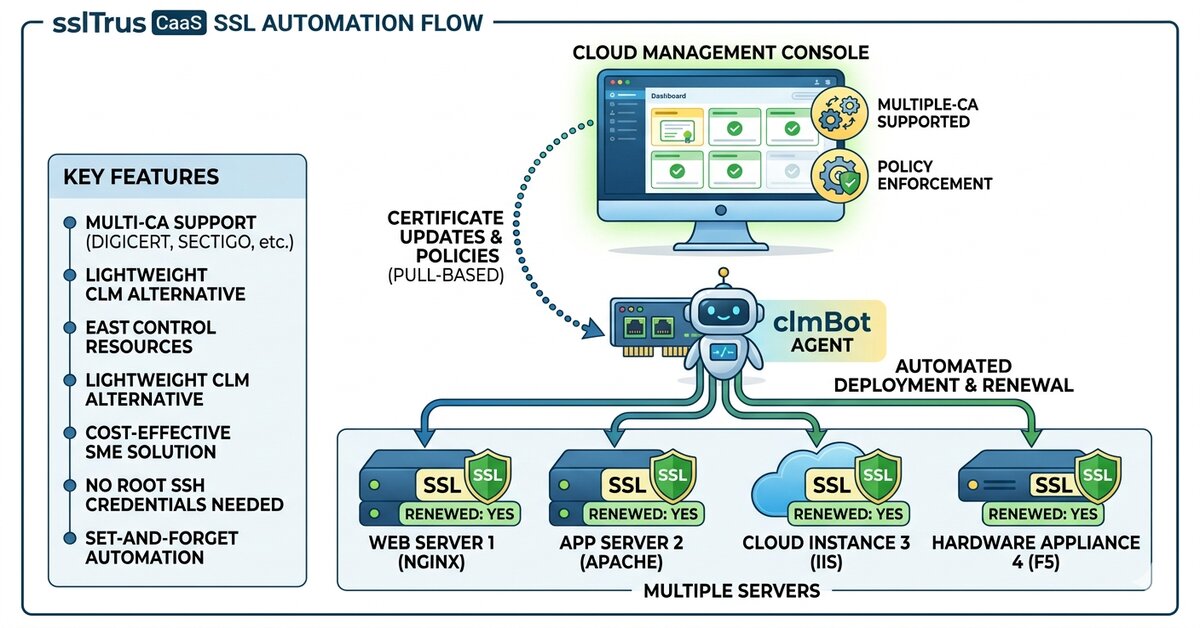
This Certificate-as-a-Service model uses a proprietary, lightweight agent to bridge the gap between cloud management and local infrastructure.
How it works: An agent (such as sslTrus CaaS and its clmBot) "pulls" certificate updates from a central cloud console. It handles local installation and service restarts automatically.
Key Advantage: It does not require sharing root SSH credentials or maintaining complex deployment scripts, reducing credential exposure and operational risk.
Best for: SMEs and businesses that require professional-grade certificates (OV/EV) or multi-brand support without the overhead of heavy enterprise infrastructure.
3. Enterprise Certificate Lifecycle Management (CLM)
CLM is a "top-down" strategy designed for large organizations with complex, hybrid infrastructures. These platforms provide a "Single Pane of Glass" to manage thousands of certificates across various environments.
How it works: Platforms such as DigiCert Trust Lifecycle Manager (TLM) use network scanners and deep API integrations to discover and manage thousands of certificates across desktops, servers, and IoT devices.
Best for: Large enterprises with strict compliance requirements, high certificate volumes, and multi-cloud environments.
4. Cloud-Native Certificate Services
Major cloud service providers (CSPs) and network hardware vendors offer built-in automation features that bypass the need for third-party software.
How it works: Services like AWS Certificate Manager (ACM), Azure Key Vault, or Alibaba Cloud CDN allow users to request and deploy certificates directly to their load balancers or CDNs via the provider's internal API.
Best for: Cloud-native applications and organizations heavily invested in a specific vendor's ecosystem (e.g., managing WAF or CDN certificates).
5. API-Driven Custom Automation
For organizations with highly specialized or non-standard environments, direct API integration is the most flexible route.
How it works: Developers use the REST APIs provided by Certificate Authorities (like DigiCert or Sectigo) to build custom scripts or integrate certificate management directly into their own DevOps pipelines (CI/CD).
Best for: Technology companies with dedicated DevOps teams who need to embed certificate management into proprietary internal tools.
Summary Comparison
| Method | Setup Complexity | Best For |
|---|---|---|
| ACME | Medium | Simple Web Servers (DV focus) |
| Agent-Based | Low | Professional Grade / Ease of Use |
| Enterprise CLM | High | Large-Scale Visibility & Compliance |
| Cloud-Native Certificate Services | Low | Cloud-Specific Assets (CDN/WAF) |
| API/Custom | Very High | Bespoke DevOps Workflows |
Conclusion: Which path should you take?
While ACME is well suited for simple web projects, and enterprise CLM platforms address large-scale governance needs, the CaaS model provides a balanced approach—combining automation, multi-CA flexibility, and operational simplicity for modern businesses. If you're still unsure which path to take, don't hesitate to contact us for a customized consultation.
NicSRS Limited
FLAT A, 20/F,ZJ 300,300 LOCKHART ROAD,Wan Chai,Hong Kong
[email protected]
RELATED
Free SSL Tools
Top Posts